







PRO-VOCEM - Probationers’ Voices Reviving Memories






Disclaimer
Funded by the European Union. Views and opinions expressed are however those of the author(s) only and do not necessarily reflect those of the European Union or the European Education and Culture Executive Agency. Neither the European Union nor the EACEA can be held responsible for them.
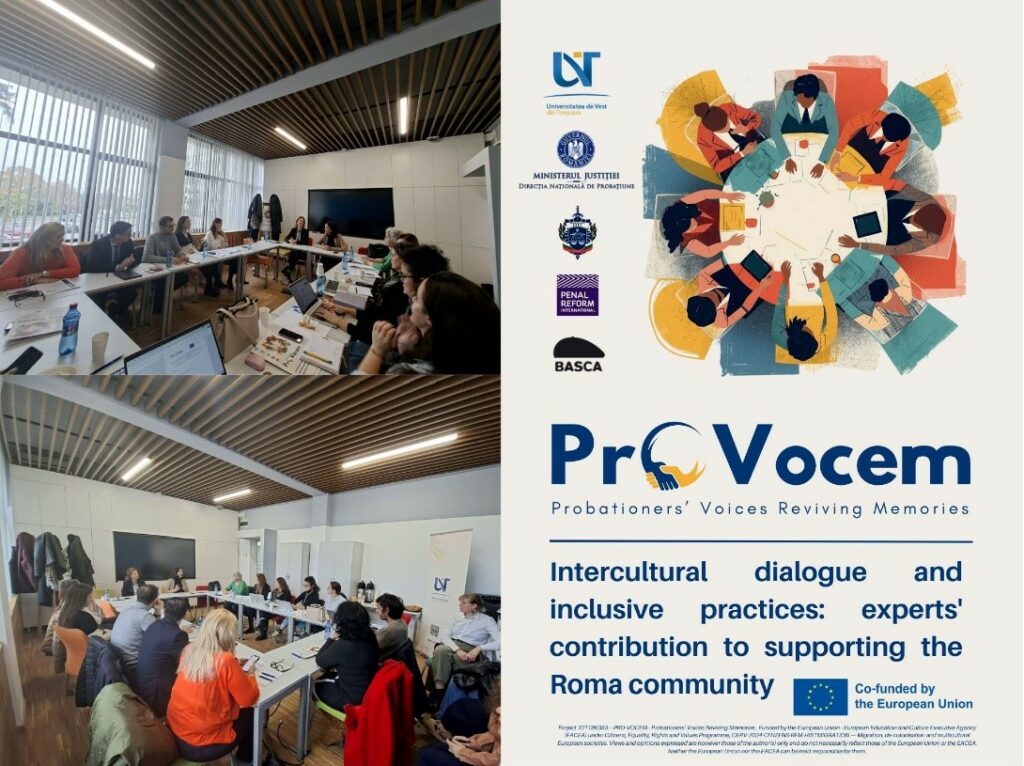
Intercultural Dialogue and Inclusive Practices
Experts’ Contribution to Supporting the Roma Community
19 th November 2025
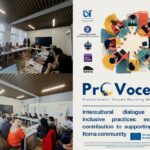
On 19 November 2025, the West University of Timișoara hosted an international round
table, bringing together 21 specialists from Romania, the Netherlands, Belgium, Germany,
Spain, Slovakia, and the Republic of Moldova. The diverse participation of probation
professionals, academic researchers, representatives of non-governmental and
international organizations, public authorities, and students ensured a strong intercultural
and multidisciplinary exchange of perspectives.
The round table aimed to strengthen dialogue between research and practice by presenting
and discussing qualitative findings from the PRO-VOCEM project, based on interviews
conducted with Roma individuals in the probation system and their families in Romania.
Key themes included identity and belonging, intersectional discrimination (with a focus on Roma women), historical memory and intergenerational
marginalization, the role of family in reintegration, and experiences within the probation system.
Participants emphasized the importance of developing culturally sensitive and trauma-informed interventions, tailored to the real needs of
communities, as well as the need to strengthen cooperation between institutions, academia, and civil society. The event contributed to advancing
evidence-based approaches and to shaping future actions aimed at promoting social inclusion, equality, and respect for fundamental rights within the
justice system.
Round Table on Research Findings
Unheard Stories: The Lived Realities of Roma Probationers in
Bulgaria
16th December 2025
On 16 December 2025, the General Directorate Execution of Sentences
in Sofia hosted an international round table within the PRO-VOCEM –
Probationers’ Voices Reviving Memories project, focused on presenting
and discussing the results of a qualitative research study on Roma
individuals under probation supervision in Bulgaria.
The event brought together representatives of public institutions,
probation services, research organizations, and civil society, fostering a multidisciplinary and intercultural dialogue. Participants included experts
from the Center for the Study of Democracy, Ministry of Justice representatives, probation professionals, and international partners.
The discussions were grounded in qualitative research based on in-depth interviews conducted with 81 Roma probationers and their family
members across four localities in Bulgaria. The study explored key dimensions such as identity and belonging, gender and intersectionality, socio-
economic challenges, discrimination, and relationships with the probation system.
Findings highlighted the complexity and diversity of Roma experiences, shaped by intergenerational marginalization, limited access to education
and employment, and persistent social stigma. Particular attention was given to gender-specific vulnerabilities, including early marriage and
unstable family contexts, as well as to the impact of structural inequalities on life trajectories.
At the same time, the research revealed important elements of resilience, including strong family and community support networks, as well as
aspirations for education, employment, and social recognition. Participants emphasized the importance of moving beyond stereotypes and actively
involving Roma voices in the design of social policies.
The round table created a valuable space for reflection and exchange, contributing to the development of evidence-based and culturally sensitive
approaches within probation and social inclusion practices. Key recommendations included strengthening collaboration between institutions and
communities, adapting interventions to real-life conditions, and promoting inclusive policies that address both structural inequalities and
individual needs.
By bringing forward “unheard stories” and lived experiences, the event reinforced the PRO-VOCEM project’s mission to support more inclusive,
participatory, and effective justice systems across Europe.
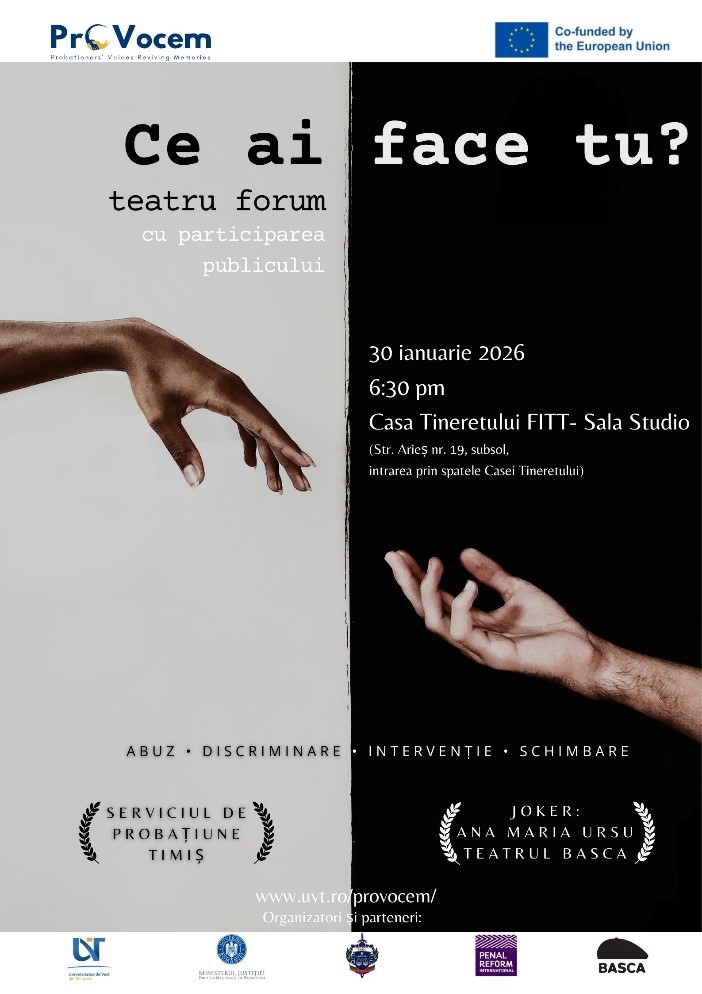
Forum Theatre Performance “What Would You
Do?”
A Participatory Experience on Social Dilemmas and Civic Dialogue
30 th January 2026
On 30 January 2026, the West University of Timișoara, in partnership with the National
Probation Directorate of Romania – Timiș Probation Service, organized the forum theatre
performance “What Would You Do?” at the FITT Studio Hall in Timișoara.
The event brought together 45 participants and offered an immersive, participatory
experience, transforming the audience from passive spectators into active contributors.
Participants engaged directly with real-life inspired scenarios addressing sensitive issues
such as discrimination, abuse, and civic responsibility, with the opportunity to intervene,
propose solutions, and reshape the course of the performance.
The performance was the result of a collaborative and educational process supporting the
development of key socio-emotional skills such as empathy, assertiveness, communication,
and self-reflection, while encouraging active participation and personal expression.
Feedback from the audience highlights the strong impact of the event. Most participants
described the atmosphere as intense and engaging, with high levels of emotional
involvement, and a large majority reported a better understanding of discrimination and
increased motivation to act against injustice. The majority of participants identified
situations similar to those presented in the performance from their own experiences.
The experience also had a significant impact on those involved in creating and performing the play. Participants reported feeling respected, heard,
and supported throughout the process, with most indicating that they developed greater self-confidence, empathy, and communication skills. Some
highlighted personal insights such as discovering their capacity for empathy, building connections with others, and becoming more aware of
discrimination and their role in responding to it. Others emphasized their intention to be more actively involved in addressing injustice.
By using non-formal educational methods, the event successfully fostered dialogue, critical thinking, and civic engagement, while giving visibility
to underrepresented voices.
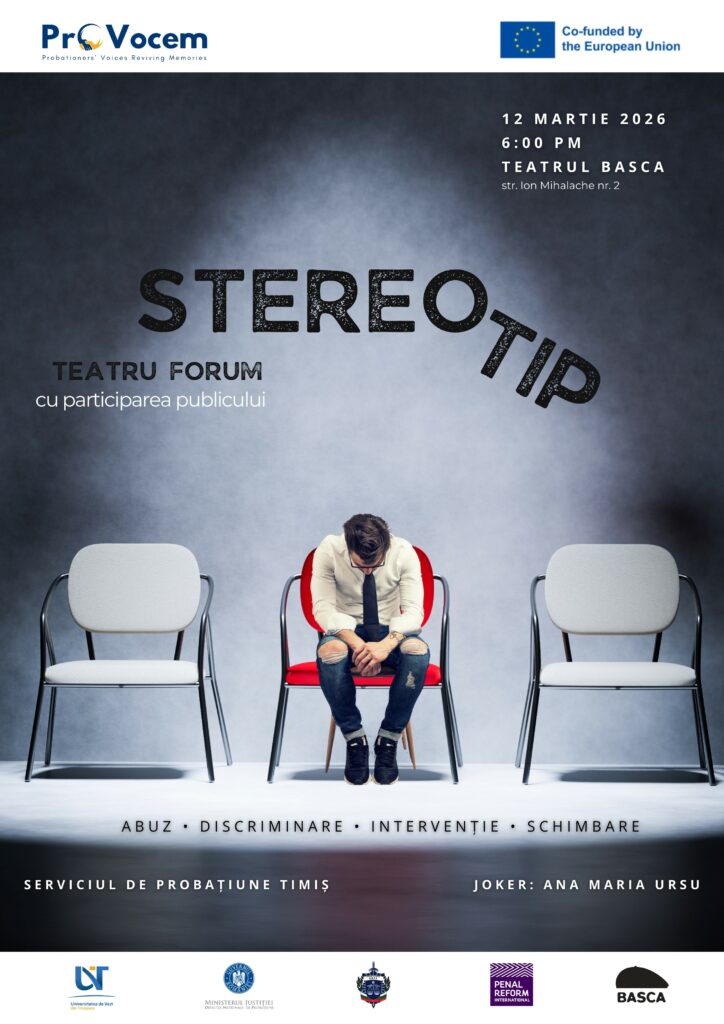
Forum Theatre Performance “Stereotip”
An interactive theatre experience that turns spectators into agents of change.
12 th March 2026
On a March evening at Basca Theatre in Timișoara, the lights did not come on just for a
performance, but for an experience that went beyond the usual boundaries of theatre.
“Stereotip” brought to the stage situations inspired by contemporary social realities:
moments of discrimination, abuse, and silence, constructed not only to evoke emotion, but to
provoke reaction.
At first, the audience watched. They listened. They followed the storyline as they would in
any other play. But gradually, something began to shift. Under the guidance of actress Ana
Maria Ursu, acting as the “joker,” the boundary between stage and audience started to blur.
Spectators were invited to intervene, to stop the action, to ask questions, and, most
importantly, to propose alternatives.
Hesitant at first, then increasingly engaged, some of them stepped onto the stage. They tried
to change the course of the story. They tested different reactions, voiced things that, in real
life, often remain unspoken. Each intervention opened up a new direction, a different
possibility, a new question about what it truly means to choose not to remain a bystander.
The situations presented did not remain mere fiction. They resonated with the personal
experiences of those in the audience, turning the performance into a mirror of reality. In that
space, participants were confronted with familiar dilemmas: when do we intervene, and when
do we remain silent? What holds us back from acting? What is our role in situations of
injustice?
The event was organized by the National Probation Directorate – Timiș Probation Service and Solidart Association, in partnership with the West
University of Timișoara, as part of the European project PRO-VOCEM – Probationers’ Voices Reviving Memories. At the heart of this initiative
lies a commitment to raising awareness about historical and contemporary forms of discrimination and social exclusion, particularly affecting
Roma individuals under probation supervision.
In the end, there was no clear sense of closure. For many of those present, the experience continued beyond the theatre walls. The questions
lingered, as did the reflections. Because once you have been invited to intervene, it becomes harder to remain passive in the face of similar
situations in everyday life.
“Stereotip” did not offer simple answers, but it opened a space in which change became imaginable. And sometimes, that first step, the ability to
imagine that things could be different, is what makes transformation possible.
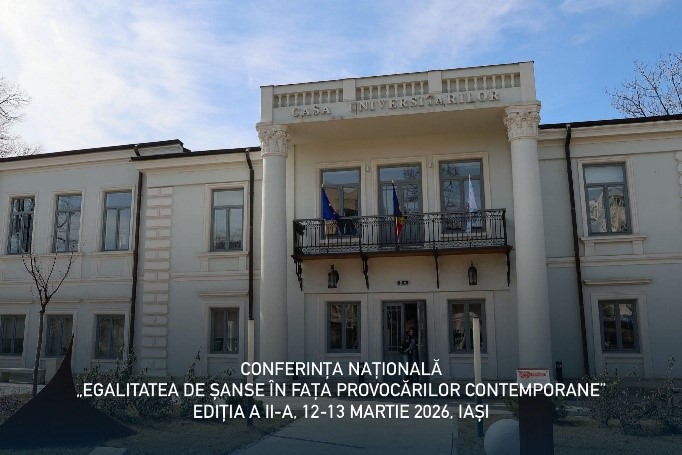
Participation in the National Conference
“Equal Opportunities in the Face of
Contemporary Challenges”
On March 12–13, 2026, the Pro Vocem
project team from Romania participated in
the second edition of the National Conference “Equal Opportunities in the Face of
Contemporary Challenges,” organized by the Department of Sociology, Social Work and
Human Resources within the Faculty of Philosophy and Social-Political Sciences of the
“Alexandru Ioan Cuza” University of Iași, in partnership with the Romanian Society of
Sociologists.
The event brought together researchers, academics, specialists, and practitioners in the field
of social sciences, providing a relevant framework for discussing current issues related to
equal opportunities, social inclusion, and society’s response to contemporary challenges.
The paper presented documents the level of knowledge and understanding of Roma history
among students in the field of social sciences, identifying sources of information, gaps, and
dominant cultural representations, including gender-related dimensions. Participation in this
national conference provided an opportunity to disseminate the project’s results, exchange
best practices, and strengthen academic and professional collaborations at the national level.
The Pro Vocem project aims to contribute to the development of innovative solutions
supporting social inclusion and active participation, and involvement in such scientific events
represents an essential step in increasing the visibility and relevance of the results achieved.